




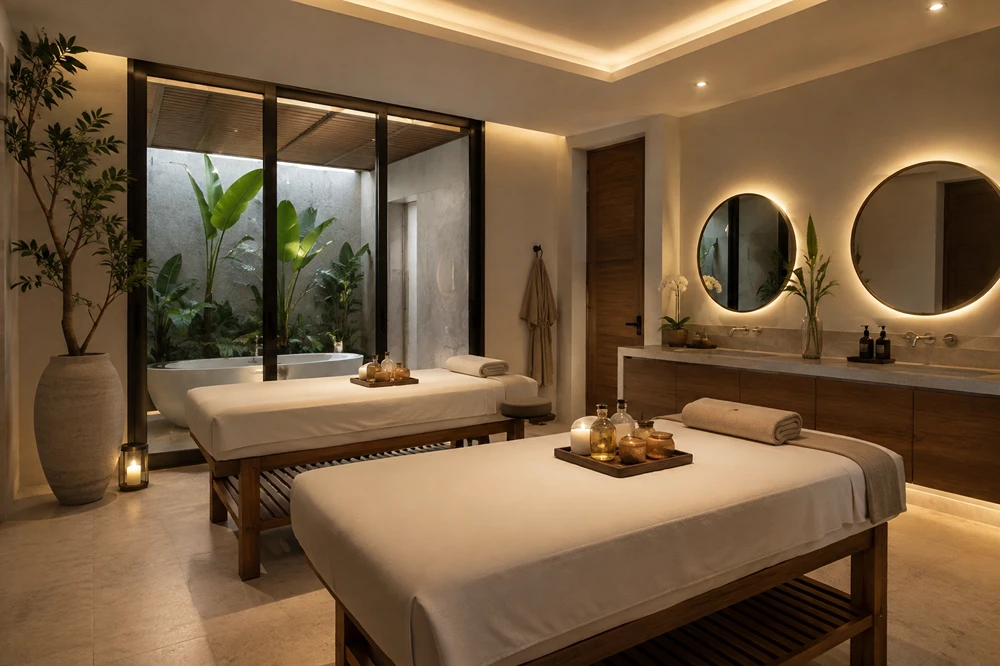
Launching a relaxation and beauty spa as a foreign-owned company in Bali can be an attractive business opportunity within Indonesia’s growing wellness and tourism industry.
Under KBLI Code 96122, spa activities are classified as tourism businesses providing health, wellness, and personal care services through a holistic combination of traditional and modern methods.
These activities may use water and other supporting treatments, including herbal massage, aromatherapy, physical exercise, color therapy, music therapy, and wellness-related food and beverages. The purpose is to help balance the body, mind, and soul, creating a relaxed and healthy condition while also supporting the preservation of Indonesian traditions and cultural practices.
In this guide, we explain the business scope, licensing requirements, operational standards, and important considerations for foreign investors planning to establish a spa business in Bali.
Table of Contents
Overview
A spa business under KBLI Code 96122 provides tourism-related health, wellness, and personal care services by combining traditional and modern treatment methods holistically.
Treatments may incorporate water and other supporting wellness methods, including:
- Traditional and modern massage;
- Herbal treatments;
- Aromatherapy;
- Physical wellness exercises;
- Color therapy;
- Music therapy;
- Relaxation programs; and
- Wellness-related food and beverages.
The official OSS classification also recognizes spa activities as part of efforts to preserve and promote Indonesia’s traditional and cultural heritage.
Legal Basis
The licensing and operation of a spa business in Indonesia are governed by several regulations, including:
- Law No. 10 of 2009 on Tourism, as amended;
- Government Regulation No. 28 of 2025 on Risk-Based Business Licensing;
- Minister of Tourism Regulation No. 6 of 2025 concerning business activity standards, supervision procedures, and administrative sanctions within the tourism sector;
- Applicable health, sanitation, environmental, building, employment, and consumer protection regulations; and
- Regional regulations applicable to the spa’s location.
Foreign investors should confirm that their proposed spa activities are open to foreign investment and comply with the applicable investment value, capital, business-scale, and ownership requirements at the time of establishment.
Type of License
A foreign investor generally operates a spa business through an Indonesian foreign-owned limited liability company, known as a PT PMA.
The company must register its business activities through the Online Single Submission Risk-Based Approach system, or OSS RBA.
Depending on the risk classification and the spa’s actual activities, the required registrations and licenses may include:
- Deed of Establishment;
- Approval from the Ministry of Law;
- Tax Identification Number or NPWP;
- Business Identification Number or NIB;
- Standard Certificate.
Under the current risk-based licensing framework, a business must hold the appropriate business license before starting and conducting its activities.
Coverage of Service
KBLI Code 96122 generally covers holistic spa and wellness treatments intended to promote relaxation, fitness, and general well-being.
The services may include:
- Traditional body massage;
- Herbal massage;
- Aromatherapy massage;
- Water-based relaxation treatments;
- Body scrubs;
- Body masks and wraps;
- Traditional wellness rituals;
- Foot and hand relaxation treatments;
- Non-medical body treatments;
- Physical relaxation exercises;
- Color therapy;
- Music therapy;
- Steam or water-based wellness facilities;
- Relaxation programs; and
- Wellness-related food and beverages.
The treatment menu should be consistent with the company’s registered business activities, approved facilities, employee qualifications, and operational standards.
Business Scale, Land Area, and Risk Level
A foreign-owned spa business is generally expected to meet the investment and business-scale requirements applicable to a PT PMA.
Under the risk-based licensing system, the required business authorization may include an NIB, a Standard Certificate, supporting business licenses, and verification of compliance with applicable tourism standards.
There is no single national minimum land-area requirement that automatically applies to every spa business.
In Bali, investors should verify that the proposed property may legally be used as a commercial spa. A building used as a private residence or villa may not automatically be approved for commercial spa operations.
Authorities Granting Licenses
The establishment and operation of a foreign-owned spa business may involve several government authorities, including:
- The Ministry of Investment and Downstream Industry/BKPM through OSS;
- The Ministry of Law;
- The Ministry of Tourism.
The specific authority responsible for issuing, verifying, or supervising each license depends on the business location, risk level, operational scope, and type of approval.
Although the principal licensing process is managed through OSS, inspections and verification may still be conducted by the relevant tourism, health, environmental, building, or regional authorities.
Requirements and Obligations for Business Licensing
To legally establish and operate a spa under KBLI Code 96122, a company must complete the applicable business licensing and maintain compliance throughout its operations.
The principal requirements and obligations may include:
- Maintaining a valid NIB;
- Obtaining and maintaining the required Standard Certificate;
- Fulfilling the applicable tourism business standards.
A spa should not make misleading medical claims or advertise ordinary relaxation treatments as treatments capable of diagnosing, curing, or preventing medical conditions.
Businesses that fail to maintain the required standards may be subject to administrative sanctions under the applicable tourism and risk-based licensing regulations. Minister of Tourism Regulation No. 6 of 2025 specifically regulates tourism business supervision and administrative sanctions.
Resources
Online Single Submission System: https://oss.go.id/
Ministry of Investment and Downstream Industry/BKPM: https://www.bkpm.go.id/
Ministry of Tourism (Kementerian Pariwisata Republik Indonesia): https://kemenpar.go.id/
Government Regulation No. 28 of 2025 on Risk-Based Business Licensing: https://peraturan.bpk.go.id/Details/319773/pp-no-28-tahun-2025
Minister of Tourism Regulation No. 6 of 2025 concerning Tourism Business Standards, Supervision Procedures, and Administrative Sanctions: https://peraturan.bpk.go.id/Details/331639/permenpar-no-6-tahun-2025
Official OSS Description for KBLI 96122 – Spa Activities: https://oss.go.id/kbli/detail/7d1b05fd-225e-44b8-9e97-eec724b678af
Frequently Asked Questions
Q: Can a spa under KBLI 96122 also offer hair, nail, and eyelash services?
A: Not automatically.
Hairdressing, hairstyling, nail treatments, eyelash extensions, eyebrow treatments, and other beauty salon services may fall under separate KBLI classifications.
A business planning to offer spa and beauty salon services should register all relevant KBLI codes and ensure that each activity is permitted for foreign investment.
Q: What makes Bali a favorable location for launching a spa business?
A: Bali has a well-established international reputation for wellness, traditional massage, yoga, natural beauty treatments, and holistic tourism.
Popular tourism areas may provide strong business opportunities, but they may also involve high rental costs, significant competition, staffing challenges, and stricter zoning or building-use considerations.
Q: What is the difference between an ordinary spa and a medical spa?
A: An ordinary spa focuses on non-medical relaxation, wellness, body care, and holistic treatments. The OSS classification for KBLI 96122 distinguishes ordinary spa activities from spa businesses moving toward a medical spa model.
A medical spa may require healthcare-sector business licenses, licensed medical professionals, facility approvals, and additional operational standards. A spa should not offer medical procedures solely under its tourism-sector spa license.
Q: Is a Certificate of Health Fitness required for a spa?
A: The OSS classification for KBLI 96122 identifies the Certificate of Health Fitness or Sertifikat Laik Sehat as a supporting business license associated with spa activities.
The exact procedures and responsible local authority may depend on the spa’s location.